Posts

Physics Photo of the Week
Image
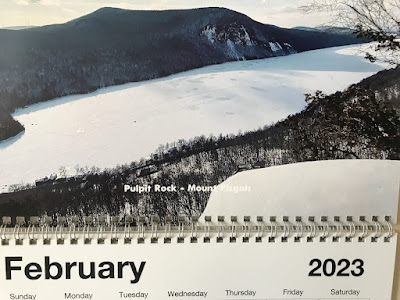
Physics Photo of the Week February 24, 2023 Freezing of lakes - calendar photo by Elaine Cashen's daughter Willoughby Lake (Lake Willoughby) in northern Vermont is an impressive mountain lake that resembles a coastal fjord that lies between two steep mountains.  The winter photo appears on a calendar produced by a fundraiser for the Westmore Association which has as its principle interest the preservation of the pristine nature of this beautiful lake.  The photo was taken from Pulpit Rock - an outcrop on the steep slopes of Mount Pisgah - easily accessible with a mile long trail - in the summer.  The mountain on the far side of the lake is Mount Hor that also show very steep slopes.   Willoughby Lake is deeper than most of the lakes in the area - reaching a maximum depth of about 330 feet roughly in the area of the shadow of Mount Hor on the snow-covered ice.  I have a habit of observing the weather satellite images of the northeastern US on a daily basis to not...
Extra Physics Photo

Image
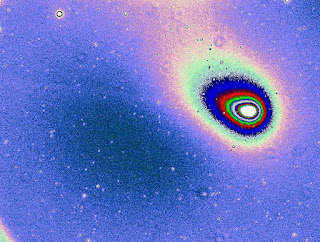
Comet ZTF update #3 - False colors for increased contrast February 16, 2023 - photograph by Donald Collins on Feb. 13, 2023   On Monday, Feb. 13, 2023, the comet did not show all these weird colors.  After all, the CCD camera used on the 14 inch telescope is a monochrome camera.  False colors were used in the processing software were used to illustrate some of the structure in the monochrome image.  The colors are chosen to indicate the brightness of the pixels involved. The previous posts of this comet that were made with the CCD camera on the 14 inch telescope showed no structure in the head of the comet because all the pixels were displayed as white in order to show any of the tail.  The head of the comet is actually brighter in the middle than it is on the sides.  The false colors, especially if the colors are chosen appropriately, show the brightness level contours - each distinct color is a contour of constant brightness - with the brightest part of ...

Physics Photo of the Week

Image
February 10, 2023 Milk: Red, White, Blue, and "Fire" Photos by Donald Collins This image of "fire" is actually a squirt of milk immersed into a vessel of clear water and illuminated from the rear by a bright flashlight.  What we see is various light scattered from the milk particles in the water before the solution was stirred.  It resembles a campfire on which we can toast marshmallows!  But it is merely cold white milk and water.  The colors are explained below.   The next image (right) is a plastic refrigerator storage bin with fresh water beside a small amount of  white milk before the milk was added to the water. Only about 4 ml of milk (about 2 teaspoons) was added to the water.   The next image (left) shows the water and milk after they have been thoroughly mixed.  The mixture is illuminated by a flashlight shining from the back.  The flashlight beam is strongly diffused by the mixture of milk and water (about 0.2% milk).  The dif...

Extra Physics Photo - Comet ZTF Feb 3

Image
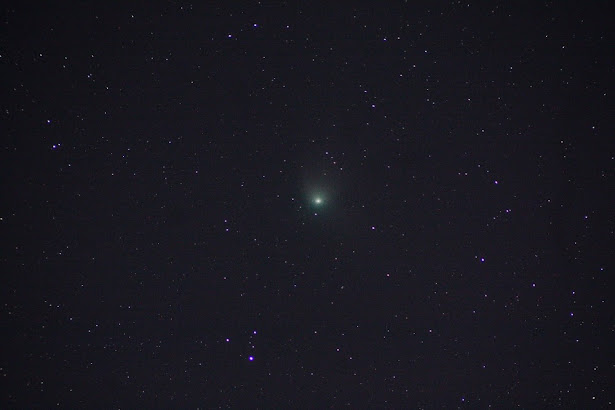
  Comet ZTF on Feb 3, 2023 from College View Observatory   A group of students suggested by a WWC faculty member gathered at my invitation to come to College View Observatory to take images of the comet: ( C/2022 E3 (ZTF)).  The designation ZTF means the Zwicky Transient Facility which received credit for its discovery in 2022.  C/2022 E3 is a serial designation assigned by the International Astronomical Union.  The photo posted above was taken with a DSLR camera mounted on a small telescope (80 mm diameter) with assistance from several of the attendees.  We had to operate the camera practically lying on our backs at the back end of the telescope.  Because the comet was high in the sky near the zenith the space to see the comet in the camera's viewfinder was very close to the floor of the observatory.  Clicking on the photo will take you to a larger zoomed-in image.  Anyone may download a copy of the image from this blog for personal use or t...

Physics Photo of the Week

Image
Physics Photo of the Week January 30, 2023 Update on Comet C/2022 E3 (ZTF) Photos by Donald Collins                   The comet featured on Jan 20 PPOW has become brighter.  The photo above was taken on January 27, 2023 using a DSLR color camera mounted on a tripod.  The dusty tail appears greenish due to the sunlight scattering off the small dust particles that are blown away from the comet. The comet was still not visible to the naked eye, but a time exposure with a normal lens on a DSLR camera barely shows the comet.  The image on the right shows a wide-angle photo of the Big Dipper on the right side of the photo.  The pointer stars point to Polaris, the North Star.   The comet last Friday was in the location of the circle, but barely visible in the photo. The original wide-angle image above was zoomed in by cropping with the computer and shown at left.  This clearly shows the comet that resembles a fuzzy...

Physics Photo of the Week

Image
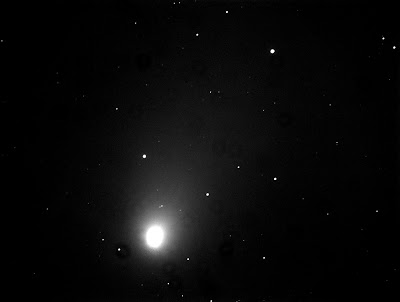
  Comet C/2022 E3 ZTF Photo by Donald Collins, College View Observatory For almost a year astronomers have been anticipating the arrival of a "major" comet in January and February of 2023.  The discovery of this comet was made by the Zwicky Transient Facility (ZTF) in March 2022. (Bob King, Sky and Telescope, January 2023)  Observations of position over the course of several weeks have enabled astronomers to calculate the precise parameters for the orbit (inclination, period, eccentricity, etc).   Anyone can download the parameters and load into a sky-viewing and telescope guiding program to direct a telescope to point to it. I made this photo the night of January 12, 2023 with the College View Observatory 14 inch telescope and CCD camera.  This photo consisted of stacking about 10 digital images of 60 seconds each.  Compared with the stars, the comet is quite bright, but we can see stars through the dusty tail.  The illumination of the comet is ...
Image
Physics Photo of the Week December 23, 2022 The Christmas Tree Nebula - Photo by Donald Collins with the College View Observatory Merry Christmas Everyone! The Christmas Tree Nebula, part of NGC 2264 consists of a cosmic cloud composed of dust and hydrogen in the constellation Monosoros - just east of Orion.  This gas/dust cloud is a busy center of extensive star formation.  The dust and hydrogen gas have been contracting due to their own self-gravity and clumps become extremely dense and begin to form new stars in the centers of the dust cloud.  Like the nearby Orion Nebula ( PPOW for February 8, 2019 ), this nebula is a stellar nursery where hot, giant, blue stars are "born".  The Christmas Tree cloud resembles a dust "pillar", which is also seen in the Orion Nebula as a dark shadow.  The bright halo surrounding the Christmas Tree cloud is a massive cloud of hydrogen that glows red and emits the red glow characteristic of a hydrogen lamp - a glass tube filled ...