Posts

Physics Photo of the Week

Image
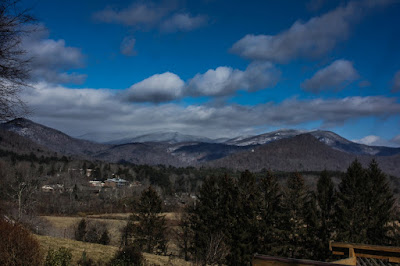
Clouds and Sunshine on Groundhog Day Photos by Donald Collins  On Groundhog Day (Feb. 2, 2024) we had nice, sunny weather with a few clouds.  The groundhog must have seen his shadow because we have had continuing cold temperatures - but no snow - for the beginning of the second half of the season.  Groundhog Day historically was chosen to occur approximately halfway between the winter solstice and the spring equinox. I had been examining the weather satellite photos (from https://weather.ndc.nasa.gov/GOES/ ) and noticed the wave-like clouds in the area northeast of my location near Warren Wilson College - the 'X' in the image (right) in western North Carolina.  These wave clouds are quite fascinating, so I grabbed my camera and looked from my deck in the direction of the clouds northeast of our house to photograph the Groundhog Day clouds in the top photo. Since clouds are dynamic - always moving - cloud photos are much more interesting if we take time-lapse photos...

Physics Photo of the Week

Image
  February 9, 2024 The Owl Nebula - and other planetary nebulae Photos by Donald Collins - College View Observatory   If we look with a telescope with some skill we can view the Warren Wilson College's mascot looking down on us.  The Owl Nebula is a class of nebulae that are called " Planetary Nebulae ".  Planetary nebulae are the remnants of dying stars.  A star like our Sun, when its hydrogen fuel is used up by fusing into helium, the resulting lack of internal radiation pressure allows the star to shrink by its self-gravity.  However, while shrinking, the core of the star becomes dense enough and hot enough for helium gas to ignite from nuclear fusion to form even heavier elements (carbon, oxygen,etc).  This second ignition blows away the outer portions of the progenitor star into an expanding cloud that we can see with telescopes. Planetary nebulae have nothing to do with planets.  The name originates because primitive telescopes ...

Physics Photo of the Week

Image
  January 26, 2024        "Rimey" Craggy s     A recent cold weather weekend (Jan 19-21, 2024) had temperatures at Warren Wilson College dip into the single digits.  January 19 was cloudy and snowy all day although very little accumulation occurred.  Clear weather on Saturday, January 20 revealed the Great Craggy Mountains that overlook Warren Wilson College were coated with rime ice from the overnight winter storm. The center of the upper photo is enlarged in the photo at right.  The distant tops of the Craggy Mountains were coated in the white rime ice that clings to the tree tops.  At lower elevations, the tree tops are bare and we see snow deposited on the ground.  Rime ice is an interesting winter formation that we experience in the mountains in winter weather.  Rime occurs when clouds exist at below freezing temperatures.  In such clouds, the cloud particles are liquid water micro drops that remain liquid....

Physics Photo of the Week

Image
December 8, 2023 M13 - A Globular Cluster - Photos by Don Collins - College View Observatory There are about 100 of these large clusters of stars orbiting the Milky Way Galaxy.  Similar clusters are found in other galaxies.  These assemblages of stars contain several hundred thousand stars and up to a million stars.  These clusters are also very old - about 10 billion years - older than the Sun and the Solar System.  Unlike open clusters (such as the Pleiades or "Seven Sisters") the globular clusters have so many stars that they are gravitationally stable.  All the stars are whizzing around a common center of mass in random orbits similar to a swarm of insects.  This globular cluster is about 20,000 light years from Earth and about 140 light years in diameter.   If our Solar System were in the midst of this cluster of close to 1 million stars, the sky would be ablaze with starlight!  However, in spite of the incredible age of the cluster, a ...

Physics Photo of the Week

Image
Physics Photo of the Week November 17, 2023 Brilliant Rainbow - Photos and diagrams by Donald F. Collins This brilliant rainbow was seen several weeks ago (October 20, 2023).  The rain that day (0.10 inch) was the final rain before the onset of a severe drought - not relieved until a light rainfall over three weeks later (0.21 inch) on November 11. Rainbows appear only when both rain and sunlight are present at the same time.  The rain drops must be illuminated directly by the sunlight for the rainbow to be visible.  In this image the rainbow appears to be between Warren Wilson College (near the foot of the rainbow) and the mountains behind the base of the rainbow.  Both the foreground, where a building of WWC is visible and the immediate background mountains as well as the rain are all lit up by direct sunshine. The picture at right shows a zoomed-in photo of the base of the rainbow.  The colors are extremely brilliant!  All the colors from red to blue are...

Physics Photo of theWeek

Image
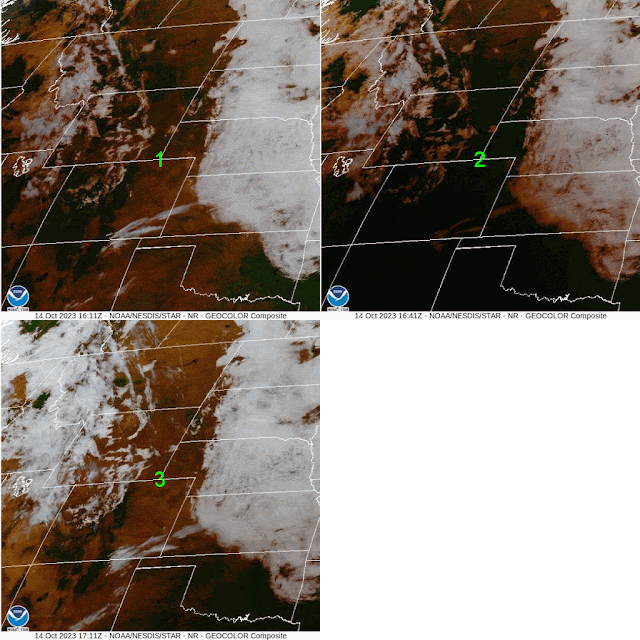
Physics Photo of the Week November 3, 2023 Moon's Shadow - Images from NASA GOES* This color satellite image (from NASA GOES image viewer ) was taken on October 14, 2023 during the partial solar eclipse (see PPOW for October 17, 2023 ).  Notice that there is no land visible in the bottom left part of the image covering parts of the American southwest.  The clouds in the upper right of the image are bright white, while the clouds near the edge of the darkest regions are tinted red.  From parts of the lower left part of the image the Moon was covering the maximum amount of the Sun's apparent disk as possible.  For this eclipse the Moon was too far away from Earth to completely cover the Sun's apparent disk, but left a narrow ring of Sun exposed.  This was an annular eclipse.  Some thin clouds are barely visible in southeast Colorado illuminated by the narrow annulus of the maximally-eclipsed Sun. Why do the clouds close to the darkest regions of the photograp...

Animation 3 frames

Image