Posts

Physics Photo of the Week - May 12, 2023

Image
  M87 - Elliptical Galaxy in Virgo: Special properties Photo by College View Observatory The object (M87) in this photo is a distant galaxy - about 50 million light years distant - a galaxy of many billions of stars within the constellation Virgo.  At first glance it resembles a "blob" - more resembling a comet without a tail than a galaxy.   Many galaxies are much more photogenic showing grand spirals, dust lanes, and other interesting structures.  M87 is a class of galaxies called  elliptical galaxies. This elliptical galaxy is also rather ordinary in first appearance in that it appears spherical rather than a football-shaped ellipsoid.  Just a "blob" of stars without any noticeable structure unlike the Andromeda Galaxy (see PPOW for Jan. 18, 2019) . However, upon close inspection of the photograph, seen much clearer in a zoomed-in photo at right, there is an apparent "jet" or ray of light made much more visible by cropping the above image and enlar...
Image
  Physics Photo of the Week April 28, 2023 - A Volcano's Mouth A recent trip to Hawai'i Volcano's National Park on the Island of Hawaii gave me and Vicki a rare opportunity to look into the most active volcano on Earth - the crater of Kilauea Volcano.  (Pronounced "kilou-way-ah"). It's amazing that a national park lets visitors venture close to a volcano - a mountain that semi-periodically erupts red-hot molten lava of temperatures hovering 1000 deg Celsius.  Volcanoes have wreaked havoc and death on a number of major cities throughout the world with their highly destructive powers. The photo at right shows a close-up of the inner crater of the Kilauea crater.  This active caldera is called the Halema'uma'u crater (pronounced "hall-lay-ma-oo-ma-oo").  This last erupted earlier this year - January-February of 2023.  See photos the eruption including visitors watching from about the vantage point of the photo at right ( https://www.nps.gov/havo...

Physics Photo of the Week

Image
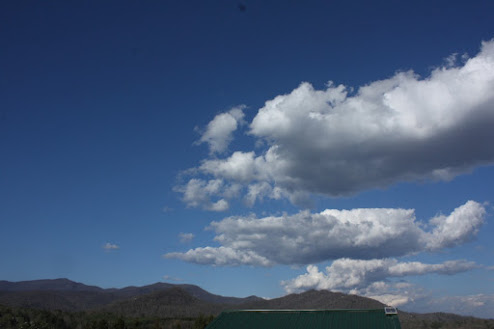
Physics Photo of the Week April 7, 2023 Cumulus Cloud "Front" - photos by Donald Collins This looks like a normal spring day with scattered fair-weather clouds.  A nice day to enjoy the spring! However, this photo presents an odd appearance of the familiar fair-weather clouds.  The clouds fill only the right half of the image.  On closer examination, the clouds all seem to be lined up and form a line extending several miles into the distance.  This line of rising clouds represents a type of "weather front".  The photograph is looking east over the Great Craggy Mountains of North Carolina.  Warren Wilson College is close by, off the lower left side of the photo.     A time-lapse (highly sped-up) video of the clouds in the video at right shows another amazing fact about these clouds. The clouds are all forming along the frontal line that lines up between west and east. The tops of the clouds are being blown to the right (south) by the higher-level b...

Physics Photo of the Week

Image
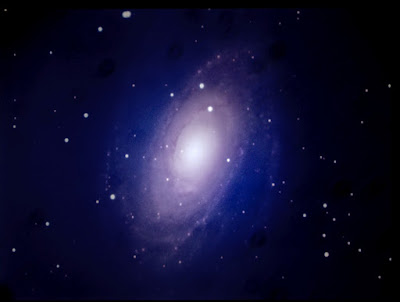
Physics Photo of the Week March 31, 2023 M81 Bode's Galaxy - Astrophoto by D. Collins (College View Observatory) Bode's Galaxy (Messier 81) can be found near the bowl of the Big Dipper asterism.  Johann Bode, an early German astronomer in 1774 discovered it - hence its name.  The Messier 81 designation was given by a contemporary French astronomer (Charles Messier) who cataloged about 100 deep sky objects that appeared as faint extended objects in early telescopes.  This photo was taken in early March of 2023. Charles Messier was a comet hunter.  Astronomers were more interested in tracking comets because they were known to be Solar System objects that moved from night to night among the stars.  In scanning the skies he needed a quick reference of the faint fuzzy objects to avoid studying - they didn't move - and he didn't want to waste time on these nebulae.  Astronomers over 200 years ago had no idea that these nebulae consisted of that resembled sprial ...

Physics Photo of the Week

Image
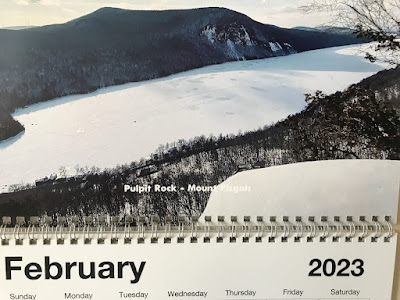
Physics Photo of the Week February 24, 2023 Freezing of lakes - calendar photo by Elaine Cashen's daughter Willoughby Lake (Lake Willoughby) in northern Vermont is an impressive mountain lake that resembles a coastal fjord that lies between two steep mountains.  The winter photo appears on a calendar produced by a fundraiser for the Westmore Association which has as its principle interest the preservation of the pristine nature of this beautiful lake.  The photo was taken from Pulpit Rock - an outcrop on the steep slopes of Mount Pisgah - easily accessible with a mile long trail - in the summer.  The mountain on the far side of the lake is Mount Hor that also show very steep slopes.   Willoughby Lake is deeper than most of the lakes in the area - reaching a maximum depth of about 330 feet roughly in the area of the shadow of Mount Hor on the snow-covered ice.  I have a habit of observing the weather satellite images of the northeastern US on a daily basis to not...

Extra Physics Photo

Image
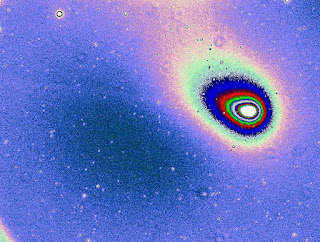
Comet ZTF update #3 - False colors for increased contrast February 16, 2023 - photograph by Donald Collins on Feb. 13, 2023   On Monday, Feb. 13, 2023, the comet did not show all these weird colors.  After all, the CCD camera used on the 14 inch telescope is a monochrome camera.  False colors were used in the processing software were used to illustrate some of the structure in the monochrome image.  The colors are chosen to indicate the brightness of the pixels involved. The previous posts of this comet that were made with the CCD camera on the 14 inch telescope showed no structure in the head of the comet because all the pixels were displayed as white in order to show any of the tail.  The head of the comet is actually brighter in the middle than it is on the sides.  The false colors, especially if the colors are chosen appropriately, show the brightness level contours - each distinct color is a contour of constant brightness - with the brightest part of ...

Physics Photo of the Week

Image
February 10, 2023 Milk: Red, White, Blue, and "Fire" Photos by Donald Collins This image of "fire" is actually a squirt of milk immersed into a vessel of clear water and illuminated from the rear by a bright flashlight.  What we see is various light scattered from the milk particles in the water before the solution was stirred.  It resembles a campfire on which we can toast marshmallows!  But it is merely cold white milk and water.  The colors are explained below.   The next image (right) is a plastic refrigerator storage bin with fresh water beside a small amount of  white milk before the milk was added to the water. Only about 4 ml of milk (about 2 teaspoons) was added to the water.   The next image (left) shows the water and milk after they have been thoroughly mixed.  The mixture is illuminated by a flashlight shining from the back.  The flashlight beam is strongly diffused by the mixture of milk and water (about 0.2% milk).  The dif...